How Much Information Do You Need?
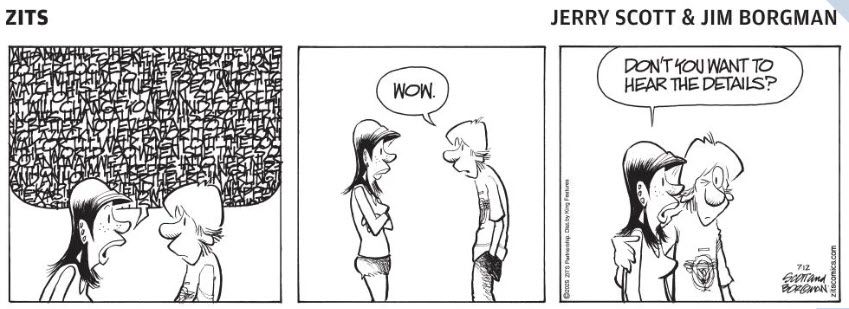
Per usual, I find the comics an enjoyable and educational way to both learn and share.
Jeremy, the 17-year-old who makes a lot of parents appreciate their male teenagers more, and Sara, his sometimes girlfriend, are the focus here.
The topic: Communication
The focus: How much information does someone need to be convinced?
The principles:
1.**We (sender) tend to provide the amount of information we would need to be convinced
- We are most effective (convincing) when we provide the amount of information the other person (receiver) needs.**
The iWAM
The Inventory for Work Attitude and Motivation (iWAM) survey has a set of scales that provide an indication of how an individual "processes convincer information".
The "Automatic" scale provides insights into how much information the individual needs in a given context:
-
Someone who scores low wants and needs a lot of information to be convinced
-
Someone who scores high, after receiving a little information, will fill in the rest of the "picture" with assumptions or their own data.
In this comic, Sara's communication suggests that she is low on the Convincer Process Automatic motivational pattern because (a) she provides a lot of information and (b) then asks if Jeremy wants to know the details.
Jeremy's expression in frame 3 suggests that he may have stopped listening at some point. This happens with those who score high on Automatic.
So What?
If we know how our patterns work in a given context (for example, I'm above average on the Automatic pattern), we can be aware of when we stop listening to someone who is providing more information than we want or need.
At the same time, I may not provide enough information to someone who scores low and wants more than is transmitted.
The bottom line is based on the principle that we are most effective when we transmit on the receiver's "channel" whether it is the same or different from our motivational channel.
If you don't know someone's motivational pattern, there are ways to infer it from verbal (e.g., "I don't quite understand what you're proposing" says a low Automatic who did not receive enough information) and non-verbal behavior (a high automatic looks at his cell phone or watch in the middle of your explanation).
There are also things you can do if you discover a mismatch.
- If you are high on the pattern and a low Automatic is providing more information than you want, you can stop them and say something like: "I want to be sure I understand what you are proposing", give a bullet summary of the key points you heard. Then ask: "Is there anything more I need to know in order for us to proceed?" The individual may pick up where they left off and continue providing more information. In this case, you stop them and say: "I'm not sure I heard whether I need